
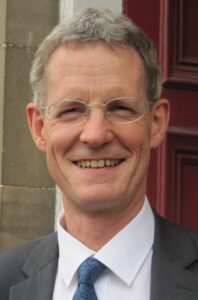
 As the staff of the General Synod of the Scottish Episcopal Church prepare to move to new modern office space in Edinburgh city centre, former Secretary General John Stuart (pictured) looks back on 102 years of history at Forbes House.
The move of the General Synod office to new premises in 2026 brings to a close a century of the occupation by the Scottish Episcopal Church of 21 Grosvenor Crescent, Edinburgh, known as Forbes House.
Grosvenor Crescent was designed as part of John Chesser’s development of the West End in the late-Victorian period. A need to provide new residential accommodation for Edinburgh’s population led to the development of what had previously been farmland to the southwest of the city’s New Town. Chesser, one of the principal terrace designers of the period, was the Superintendent of Works to George Heriot’s Hospital between 1858 and 1889. During his term of office large quantities of Heriot’s land were feued, including land in the west of Edinburgh. Facing Lansdowne Crecent, on the opposite side of central shared gardens, Grosvenor Crescent conveyed the sense of aesthetics and community designed to appeal to the professional and mercantile classes of Edinburgh’s population. Construction was completed the early1870s. No 21 would become a category B listed building in 1964. The listing recognises both the building’s architectural interest and the contribution which the Crescent makes to the wider 19th-century townscape.

(The adjacent Coates Hall, former Theological College, now St Mary’s Music School
No 21 came into the ownership of the Scottish Episcopal Church in 1924, as an extension for Coates Hall, the Church’s Theological College. Records indicate that it had been the residence of a “Mrs Dalrymple” around the turn of the century. However by the time of the sale to the Church in the 1920s, the owner was Harry George Younger, a director of William Younger & Co, the Edinburgh brewing company. He appears to have been a man of some means having both a family estate in Argyll for country pursuits and a fashionable Edinburgh townhouse at No 21 for city living.
 In the years following the First World War, Coates Hall was becoming increasingly cramped. By 1923, it was reported that congestion in the library had become acute, partly through the purchase of new books (at the rate of more than 100 each year) and partly through the gift of books by donors.
When Mr Younger offered to sell 21 Grosvenor Crescent, lying immediately adjacent to Coates Hall, it must have seemed a heaven-sent solution. Not surprisingly, his offer was accepted and in 1924 the building was bought for the sum of £4000, funded in part by an appeal to the wider Church.
Amongst the treasures of the Theological College was the George Hay Forbes library, which included extensive patristic and liturgical texts. George Hay Forbes (1821-75), the brother of Alexander Penrose Forbes, Bishop of Brechin, had been a notable clergyman in the Episcopal Church in his own right. He was responsible for building the episcopal church in Burntisland and for founding the Pitsligo Press. His library was placed on the first floor and staircase of the newly-acquired property. The bedrooms on the upper floor were to be used to accommodate additional theological students. The building, boasting its theological library, at once came to be known as “Forbes House” and the name stuck.
The new premises were ready for use by the commencement of the Advent Term in October 1924. The total student complement at that time was 27 of whom 8 were housed in Forbes House and it was noted at the time that “some of the rooms are splendid and all are better and sunnier than those in Coates Hall….considerable expense was incurred in laying linoleum and providing furniture etc”. However, despite hopes that the premises would soon house many new students, there were in fact insufficient students to fill the building. It was only in 1930 that it ceased to house clerical lodgers.

(Spot the difference: Forbes House 60 years ago. Only the cars have changed)
As the years passed, the needs of the Theological College evolved, resulting in changes to the Coates Hall campus. In the late 1960s an extension to the main College building was erected and, in 1969, a new house for the Principal was constructed in the rear grounds. A report on Forbes House described it as a building “not originally built for the purpose for which it is used and maybe economically extravagant in maintenance and running costs”. Surplus to the needs of the College, the question was whether to sell or apply it to alternative church use. It was not long before a relocation of the offices of the Representative Church Council (RCC) into the building was mooted. The College Bursar, Ian Stuart, who was also the Secretary and Treasurer of the RCC, viewed the property and “thought the accommodation quite suitable from the point of view of the RCC central office requirements”. So it was that in 1970, after planning permission for change of use had been obtained and various works undertaken to render the building suitable for office use, the RCC moved in from its offices at 13/14 Drumsheugh Gardens. After Ian Stuart’s death in service in 1985, Room 13 in Forbes House was dedicated to his memory. It had served as the billiard room in the days of Mr H G Younger. The George Hay Forbes Library ended its association with the building and was sent to the University of St Andrews on permanent loan.

(The entrance to Forbes House)
After the office move in 1970, Forbes House accommodated the various functions of the RCC. As well as the servicing of the boards and committees of the Council and the handling of its finances, these included the operations of the Church’s Social Services Board which, from the basement, provided a professional casework service for unmarried mothers and encompassed the work of the Scottish Episcopal Adoption Society. The proximity of the new office to Haymarket Station proved a particular boon, enabling ready access for those travelling from other parts of the Province. When the RCC and the former Provincial Synod were dissolved and replaced by the General Synod in 1982, the RCC offices at Forbes House morphed into the General Synod Office (GSO). Over the years many people passed through its doors, not just members of the Episcopal Church but those from other parts of the Anglican Communion, including various Archbishops of Canterbury, and colleagues and partners from other denominations and faiths. It also proved possible to provide office space to other bodies connected to the SEC including the Scottish Episcopal Church Mission Association (Links) and Faith in Older People. In due course the basement of Forbes House was converted into two student flats to accommodate married students and their families.

(Archbishop Desmond Tutu and his wife Leah visit Forbes House in 1995)
So, the Theological College at Coates Hall and the Provincial Office at Forbes House lived as next-door neighbours until further developments in the life of the College led to yet further change. By the late 1980s it was becoming clear that, for a variety of reasons, the College could not continue in its then current form. As a result, Coates Hall closed and in 1994 was sold to St Mary’s Music School. The Theological Institute Church of the Scottish Episcopal Church (TISEC) was created as a largely non-residential institution but with a small administrative office in the Inverleith area of Edinburgh. The basement of Forbes House was no longer required as married student quarters and was refurbished as office accommodation. In 1995, the Diocese of Edinburgh took the opportunity to move from its former offices in the Walpole Hall, adjacent to St Mary’s Cathedral, and agreed a long-term lease for the basement with the Province. So, the GSO lost one neighbour in the form of the Theological College but welcomed another in the Diocese of Edinburgh.

(The Diocese of Edinburgh moved into the basement of Forbes House in 1995)
The close residential association between the GSO with the Church’s training and formation function would, however, be renewed again before long. By 2004, TISEC had been in existence for ten years and was by then occupying premises in Old Coates House, situated between the Walpole Hall and St Mary’s Cathedral for its office and library. A review, which reported that year under the name New Century, New Directions, resulted in a number of changes to TISEC’s operations. In what might be seen as the wheel turning full circle, these included the relocation of TISEC’s fulltime staff from Old Coates House to Forbes House. Once again, Forbes House had found a role in supporting the training of the Church’s clergy and lay readers. In due course, following a further review reported to the General Synod of 2014, TISEC was replaced by the Scottish Episcopal Institute, whose fulltime staff continue to work from the provincial office. Until the Covid-19 pandemic the building was once again hosting students attending weekly evening seminars.

(The library in Room 4 on the ground floor)
Throughout the Church’s ownership of the building, maintenance of the fabric has proved a constant necessity. Over the decades a range of work has been undertaken. The alterations to render the building a suitable home for the RCC in the late 1960s included the installation of a lift, which over the years aged with a certain nostalgia for its heyday but which required ever greater support in its dotage until its final descent, perhaps fittingly, during the Covid-19 pandemic. In its working years, the lift had been cherished by both staff and visitors as a quaint, if at times bone-shaking, alternative to climbing four flights of stairs.

(This former billiard room at Forbes House was later dedicated to Ian Stuart, father of John Stuart and one of his predecessors as Secretary General)
In 1996, a major programme of repairs, phased over several years, was undertaken at significant cost and with the assistance of substantial grants obtained from Historic Scotland (later Historic Environment Scotland). The internal re-wiring was replaced and updated about ten years later and a ramp at the rear of the building to enable wheelchair access was added in 2014. Nevertheless, without very substantial internal alteration and re-configuration, a building such as Forbes House does not easily lend itself to the needs of modern office practices such as open plan working and a move has seemed inevitable for some time. Unsurprisingly, therefore, in 2025 the Standing Committee of the General Synod decided to seek new premises.

(Bishop Bruce Cameron, former Primus – on the right – with a staff liaison group in Room 5)
What the future will hold for Forbes House remains to be seen, but let us hope that, after 100 years of church use, it will continue to be loved and cared for in the centuries to come. For generations it has occupied a unique place in the hearts of Episcopalians, and others. It will live on in our denominational memory long after the last staff member to leave the office turns the key in the front door lock for the final time.
John F Stuart was Secretary General of the General Synod of the Scottish Episcopal Church from 1996 to 2024.