
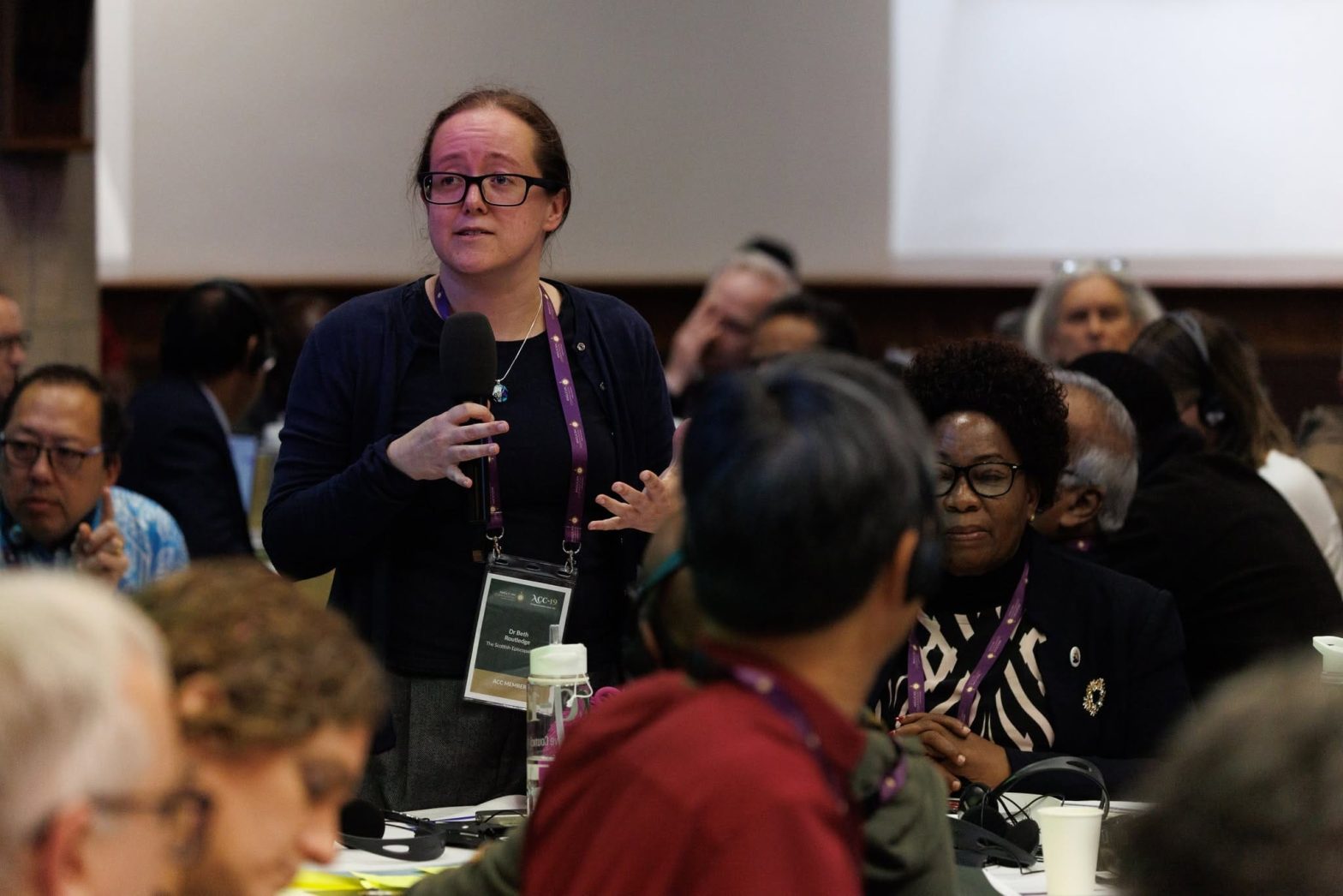
The Scottish Episcopal Church’s representatives at the 19th meeting of the Anglican Consultative Council (ACC-19) in Belfast have written of an “honest and graceful” outcome to discussions about the shape and identity of the Anglican Communion.

Dr Beth Routledge and the Very Rev Kelvin Holdsworth attended ACC-19 where one of the principal items of business was the Nairobi-Cairo Proposals. Developed by the Inter-Anglican Standing Commission on Unity, Faith and Order, the proposals sought to address the structure and decision-making in the Anglican Communion to help address differences and disagreements.
The Scottish Episcopal Church had examined the proposals closely in various forums before the meeting and responded twice with concerns about the proposed changes to the definition of the Anglican Communion and the place of the See of Canterbury within its identity. The 2026 meeting of the General Synod had also requested the delegates to ask for amendments to the proposals in accordance with those responses, which can be read here, and here.
Dr Routledge reported that they soon discovered that concerns about the proposals were widely shared among delegates. She writes: “Far from my concerns that Scotland might be the odd province out in its objections, it had already become clear that the majority of the room did not think that the proposals got us to where we needed to be.
“The mood in the room seemed to be: better to have the hard conversation, better to talk frankly about our different opinions and about where we have come from and how we got there.”

Provost Holdsworth said the proposals acknowledged division within the Communion without sufficiently addressing its causes, writing that: “More than one person spoke to me … to express surprise that they had just discovered that the Nairobi-Cairo Proposals were related at all to the divisions about human sexuality that have surfaced in recent years in the Communion. This was not clear from the text … It was also not really very clear to the Council that these proposals would help very much at all.”
One proposal would have redefined the Communion as churches having “a historic link to the See of Canterbury”, rather than churches in communion with it. Provost Holdsworth writes that: “for those of us who come from churches which don’t have a historic connection with the See of Canterbury in the sense of being founded by missionaries from England, that change rather stuck in the throat. In the end, the Council wasn’t terribly minded to move in that direction.”
“The resolution we passed is a little messy, a little imperfect, but it is honest and it is graceful,” said Dr Routledge.

In addition to the Nairobi-Cairo Proposals, ACC-19 delegates held discussions on evangelism, migration, refugees and the environment. During one session the work of the International Anglican Liturgical Consultation (IALC) was presented by Dr John Reuben Davies, a member of the Scottish Episcopal Church Liturgy Committee (Convener, 2015–2020) and a member of the IALC steering committee.
Reflecting on the daily celebration of the Eucharist during ACC-19, Dr Davies spoke of the Eucharist as “the heart of the Church’s life: the place where Christians are formed in Christ, where our communion is expressed and deepened, and from which we are sent into the world in God’s mission.”
In the middle of the week delegates went on pilgrimage to Derry/Londonderry, where they heard from Richard Moore, who was blinded as a child by a rubber bullet fired by a British soldier and later forgave and befriended him.

Provost Holdsworth said that Richard’s testimony showed that “Reconciliation does not come cheap in Northern Ireland and this and other stories of the Troubles formed the backdrop to an extraordinary week of conversation about the Anglican Communion.”
He wrote that he returned from Belfast with “a deep sense of awe and wonder”: “My overriding sense of the end of ACC-19 was that the bonds of affection were deep and had been deeply renewed by the experience. We all loved one another. And there is no new schism to be had this time.”
Dr Routledge concluded that: “The Anglican Communion is a real thing. The bonds of affection that we talk about – that are the only things that really hold us together — are real things, too, and they are as strong and precious as diamonds.”
“If you are a member of a Scottish Episcopal Church … you will know the rhythm of the Anglican Cycle of Prayer. It comes as a regular part of our daily prayer, as each day we pray for a different part of the world. In coming weeks, we will pray for the Diocese of Bermuda, the Diocese of Armagh, the Diocese of Auckland in the Anglican Church of Aotearoa, New Zealand, and Polynesia, and the Anglican Church of Tanzania, among others. That part of our prayer is no longer an abstract thing for me. Those places have names attached to them, and stories, and friends.”
Both Dr Routledge and Provost Holdsworth have written excellent reflections on their time at ACC-19. You can read them here:
- https://bethroutledge.substack.com/p/letter-from-belfast
- https://thurible.net/2026/07/10/acc-19-the-anglican-consultative-council-in-belfast/
Day-by-day reporting of ACC-19 can be read at the Anglican Communion News Service here.
You can find the full list of resolutions passed at ACC-19 here.
–
All images by Neil Turner for the ACO
The post Scottish representatives reflect on ‘honest and graceful’ outcome of ACC-19 appeared first on The Scottish Episcopal Church.